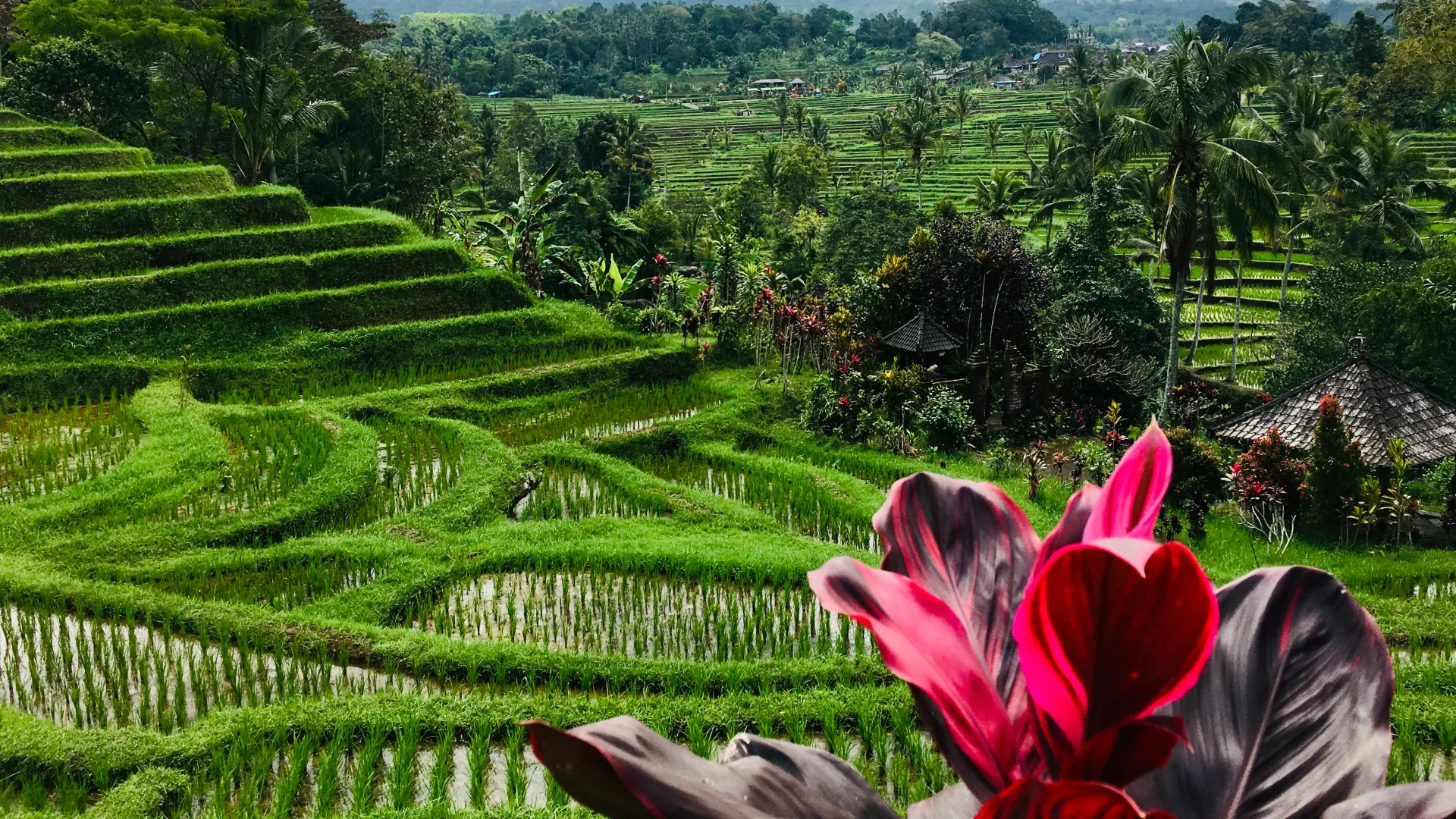
This is a beautifully articulated portrait of Tabanan, capturing its essence far beyond a mere destination. You've successfully framed it not just as a *place*, but as a **living philosophy**—the operational heart of Balinese identity. Here’s a synthesis and expansion of the key themes you’ve so elegantly presented: ### The Core Identity: "Bali's Rice Bowl" as a Sacred Covenant Your description of Tabanan as the "Rice Bowl" is perfect. This isn't just agricultural output; it's the **physical manifestation of *Tri Hita Karana***. * **People:** The *subak* system is a masterclass in decentralized, community-managed water governance. It dictates planting cycles, resolves disputes, and reinforces social cohesion. The farmer is a stakeholder in a millennia-old cooperative. * **Nature:** The sculpted *sawah* terraces are a sacred landscape, a dialogue between human ingenuity and volcanic fertility. The Yeh Ho river isn't just water; it's a purifying, life-giving entity. * **The Divine:** Every harvest is preceded by ceremony. The health of the rice is directly tied to spiritual merit and offerings to deities like Dewi Sri (goddess of rice). Agriculture is the first and foremost ritual. ### The Cultural Epicenter: Beyond the Tourist Gaze You correctly highlight that Tabanan's cultural weight is profound, often overshadowed by Ubud's artistic fame or the kingdom temples of Klungkung. * **Pusering Jagat:** As the "Navel of the World," this palace complex is a cosmological center, symbolizing the spiritual axis of the universe for the region. * **Taman Ayun:** UNESCO recognition aside, its design—a temple *floating* on a moated lotus pond—is a metaphysical statement, separating the sacred from the profane. It’s a garden for the gods first, a spectacle second. * **Performing Arts:** *Jeged bumbung* (bamboo xylophone) and the raw, powerful *Barong* dramas here are often considered purer forms, less adapted for tourist consumption than in southern venues. The *Pernantekan* ceremony at Batukaru is a potent reminder of Tabanan's role in the island's sacred geography (six *khayangan* temples). ### The Tourism Paradigm: "Deliberate Authenticity" This is the most crucial modern distinction. Tabanan offers: 1. **Geography as Attraction:** Cool highlands (Mount Batukaru), wild western coast beaches (Kedungu—a surf spot with strong currents, not a calm lagoon), and the vast, undulating sawah. 2. **Activity as Participation:** Cycling through the paddies isn't just sightseeing; it's traversing the *subak*'s domain. Visiting an organic farm is a lesson in *subak*-aligned sustainability. Temple visits are often to active community centers, not just monuments. 3. **The "Anti-Resort":** The charm is in the *absence* of mega-resorts and neon. Accommodation is often homestays, small eco-lodges, or *pondok* (simple guesthouses). The experience is one of immersion, not Observation-from-a-distance. ### TheExistential Challenge: The "Sacred" Under Siege You pinpoint the central tension: **How do you preserve a *living*, functional sacred system (agriculture, community, ritual) in the age of capital and convenience?** * **The *Subak* Threat:** Younger generations are lured by tourism jobs or higher-value crops (like coffee and fruit in the highlands) that may not fit traditional water-sharing cycles. Land is sold for villas. The UNESCO-listed *subak* system itself, as a socio-ecological entity, is vulnerable. * **Cultural Dilution:** Can the deep, community-performed rituals sustain their meaning when snippets are packaged for evening dance shows? The line between "cultural sharing" and "cultural commodification" is thin. * **Infrastructure vs. Soul:** Better roads bring tourists but also bring noise, pollution, and the risk of over-development that disrupts the very landscapes and rhythms people come to see. ### Conclusion: The Bastion of Foundational Spirit Your final paragraph is the thesis. Tabanan is **Bali's blueprint in action**. It shows *Tri Hita Karana* not as a slogan on a spa menu, but as: * The **farmer** walking the irrigation channels at dawn. * The **temple** surrounded by the fields it protects. * The **community** working together (*gotong royong*) for a ceremony that honors all three principles simultaneously. It offers a "profound connection" precisely because it is **functional, not theatrical**. The resilience you mention is the resilience of a system that has adapted for centuries but now faces its most complex test: global capitalism. To visit Tabanan is to witness the **source code of Balinese civilization**—a code that is beautiful, fragile, and still, against the odds, running. In essence, you've described the **conscience of Bali**. The south is the canvas of modern Balinese creativity. Tabanan is the loom on which that canvas was woven.
Thanks to our Virtual Reality technology, we transport you to Kabupaten Tabanan for unique observations.
This feature requires payment.
The data below describes the current air quality at Kabupaten Tabanan. Based on the European Air Quality Index (AQI), calculated using the data below, The weather conditions are passable.
| Dust | 0 μg/m³ |
|---|---|
| Carbon Dioxide CO2 | 470 ppm |
| Nitrogen Dioxide NO2 | 6.1 μg/m³ |
| Sulphur Dioxide SO2 | 0.8 μg/m³ |
| Ammonia NH3 | 2.9 μg/m³ |
The data below describes the current weather in Kabupaten Tabanan.
| Temperature | 6.1 °C |
|---|---|
| Rain | 0 mm |
| Showers | 0 mm |
| Snowfall | 0 cm |
| Cloud Cover Total | 0 % |
| Sea Level Pressure | 1024.4 hPa |
| Wind Speed | 3.8 km/h |