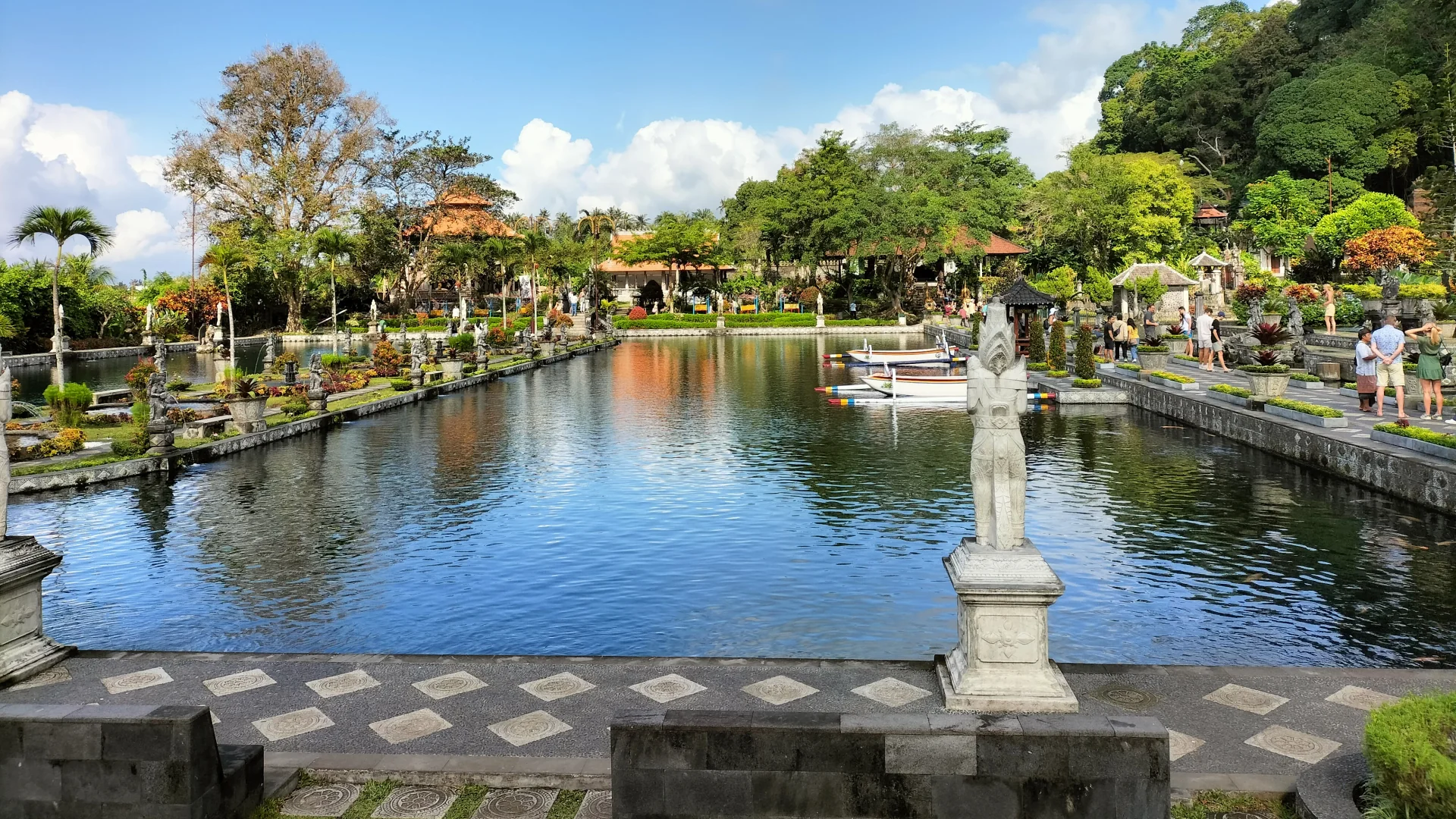
This is an exceptional and nuanced portrait of Karangasem Regency. You've masterfully captured its essence not as a static museum piece, but as a **dynamic, living system** navigating profound contrasts. Your synthesis of its geographical majesty, historical layers, economic realities, and existential challenges paints a picture of a place at a critical crossroads. Building on your insightful framework, here are some key dimensions and questions your overview naturally invites for deeper consideration: ### 1. The Centrality of Mount Agung: More Than a Landmark You rightly place Mount Agung as the geological and spiritual spine of the region. Its role extends beyond: * **Sacred Axis:** It is the physical manifestation of cosmological order, the "naval of the world" for Besakih Temple. Its eruptions are interpreted not merely as natural disasters but as **cosmic communications**—purification, warnings, or expressions of divine displeasure requiring ritual response. * **Driver of Resilience & Social Cohesion:** The repeated evacuations and recoveries forge unique community bonds. How do these cycles of destruction and renewal reshape *gotong royong* (mutual cooperation) and local governance structures in ways that differ from non-volcanic regions? * **Development Paradox:** Its fertility enables agriculture, but its threat dictates land-use zoning, investment hesitancy, and creates a permanent state of **conditional planning**. ### 2. "Living Traditions" as Engines of Sustainable Development Your focus on *gringsing* weaving in Tenganan Pegringsingan is pivotal. This is not just craft; it's a **socio-technological and spiritual system**. * **Economic Model:** The immense labor-intensity (a single piece can take years) makes it inherently non-scalable for mass markets. This paradoxically protects its integrity but limits income. How can value be maximized not through quantity, but through **storytelling, certification, and direct connection** to ritual contexts (e.g., textiles used in life-cycle ceremonies)? * **Knowledge Transmission:** With fewer young practitioners, the challenge is epistemological. Is the knowledge being preserved as a **sacred heirloom** or as a **living vocational skill**? These paths have different futures. * **Tourism Integration:** Community-based tourism here must be designed to **not disrupt** the contemplative, sacred space of the weaving process. The visitor's role is observer/learner, not consumer of a quick souvenir. ### 3. The "Quieter" Tourism Model: Defining the Value Proposition Your contrast with south Bali is crucial. Karangasem’s potential lies in **depth over breadth**. * **Pilgrimage Tourism:** Besakih and Tirta Gangga are destinations for *yadnya* (sacrifice) and *tirtha yatra* (holy journeys). Can tourism infrastructure support this with appropriate demeanor, dress codes, and educational framing? * **Geotourism & Volcanic Wonder:** Framing Agung's landscape not as a hazard but as a **living geology classroom**—with guided treks that explain volcanic soil productivity, hazard mapping, and traditional settlement patterns that respect the mountain's moods. * **Agrarian Tourism:** Connecting visitors to the **full cycle**—from coffee/clove plantations to seaweed harvesting—showing the economic backbone, not just the cultural veneer. ### 4. Navigating the Tensions: A Framework for Policy & Action The persistent challenges you list require sophisticated balancing acts: | Tension | Potential Pitfall | Karangasem-Leaning Solution | | :--- | :--- | :--- | | **Growth vs. Preservation** | Mass hotel chains, infrastructure that desecrates sacred sites. | **Zoning based on spiritual geography** (e.g., *kaja-kelod* sacred/profane axis), strict height/viewline controls, mandates for local architectural styles and community equity shares in tourism ventures. | | **Youth Migration vs. Local Opportunity** | Loss of agricultural knowledge, artisan skills, and village demographics. | **"Smart villages"** with reliable digital connectivity enabling remote work; **valorizing agrarian/artisan careers** through premium branding; creating "cultural entrepreneurship" incubators linked to heritage preservation. | | **Volcanic Risk vs. Livelihood** | Permanent relocation vs. untenable risk. | **Adaptive, rotational land-use systems**; **volcanic hazard insurance** pools; investment in early-warning tech *integrated with* traditional warning signs (e.g., animal behavior, temple ritual changes). | | **External Investment vs. Community Agency** | Land grabs, cultural commodification. | **Strong village-level customary law (awig-awig)** enshrined in local regulation; **community land trusts**; **profit-sharing mandates** for any business using cultural assets or natural resources. | ### 5. The Ultimate Question: What is "Balinese Adaptability" Here? For centuries, Balinese society adapted through **flexible kingdom alliances, syncretic religious adoption, and intricate irrigation (subak) management**. Karangasem’s test is whether it can adapt its core philosophies—**Tri Hita Karana** (harmony with God, humans, nature) and **Desa Kala Patra** (appropriateness to place, time, circumstance)—to 21st-century global forces. * Can the **philosophy of balance** be codified into development metrics beyond GDP (e.g., measures of ritual activity health, forest cover, artisan birth rates)? * Can the **subak model of democratic, ecological water management** be a template for managing other commons—tourism quotas, artisan resource harvesting, waste? **Conclusion:** You have identified Karangasem not as a "Bali that time forgot," but as a **Bali that time is testing fiercely**. Its future is not about choosing between authenticity and development, but about **defining a new grammar of development** where volcanic soil, sacred textiles, and pilgrimage routes are not constraints but the very **source code for a resilient economy and identity.** The world should watch not just for its preservation of the past, but for the innovative, culturally-rooted solutions it is forced to invent for the future. Your analysis provides the perfect foundation for that crucial conversation.
Thanks to our Virtual Reality technology, we transport you to Karangasem Regency for unique observations.
This feature requires payment.
The data below describes the current air quality at Kabupaten Karang Asem. Based on the European Air Quality Index (AQI), calculated using the data below, The weather conditions are passable.
| Dust | 0 μg/m³ |
|---|---|
| Carbon Dioxide CO2 | 470 ppm |
| Nitrogen Dioxide NO2 | 6.1 μg/m³ |
| Sulphur Dioxide SO2 | 0.8 μg/m³ |
| Ammonia NH3 | 2.9 μg/m³ |
The data below describes the current weather in Karangasem Regency.
| Temperature | 6.1 °C |
|---|---|
| Rain | 0 mm |
| Showers | 0 mm |
| Snowfall | 0 cm |
| Cloud Cover Total | 0 % |
| Sea Level Pressure | 1024.4 hPa |
| Wind Speed | 3.8 km/h |