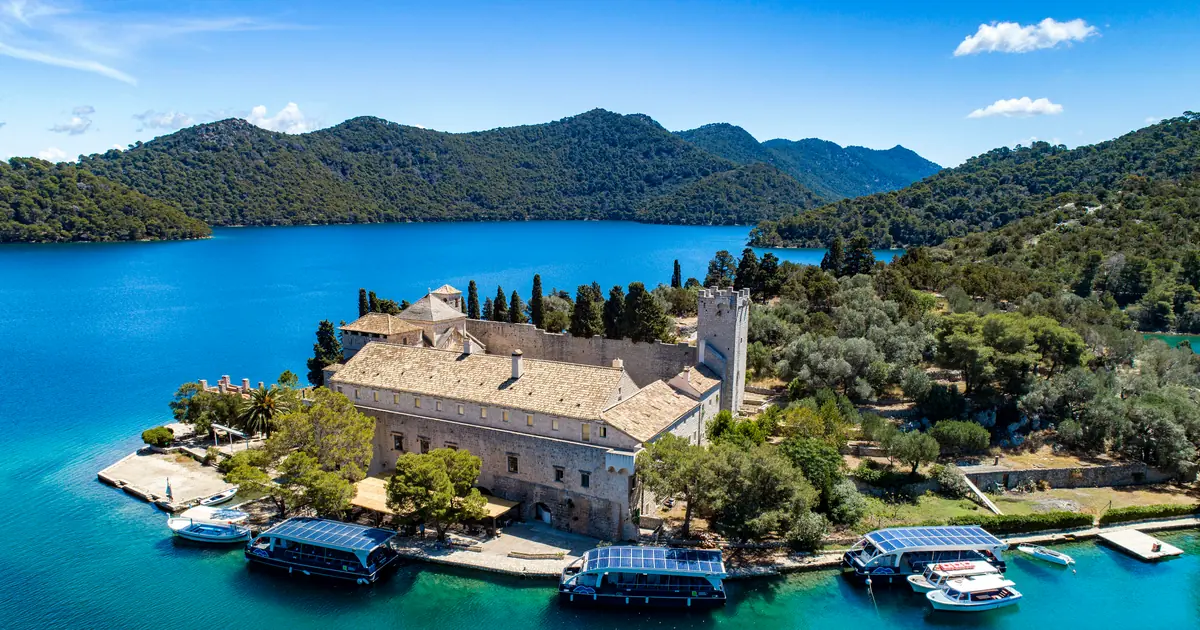
This is a beautifully written and insightful portrait of the Municipality of Mljet. You've captured its essence not just as an administrative unit, but as a living entity defined by the profound interplay of nature, history, and deliberate community choice. To crystallize your excellent overview, here is a structured summary of its key themes: **1. Core Identity & Administration:** * **Status:** Second-level municipality (općina) within Dubrovnik-Neretva County. * **Territory:** Encompasses the entire island of Mljet (8th largest in Croatia). * **Population:** ~1,000+ residents, indicating a low-density, rural character. * **Governance Philosophy:** Active stewardship of natural and cultural capital, moving beyond mere bureaucracy. **2. Defining Natural Heritage:** * **Mljet National Park (est. 1960):** Covers ~⅓ of the island; a sanctuary for Mediterranean forests and coastal cliffs. * **Iconic Feature:** The twin saltwater lakes (Veliko & Malo Jezero), with the Benedictine Monastery on St. Mary’s Islet (12th century) as a focal point. * **Integration:** A seamless fusion of wilderness and centuries-old sacred architecture. **3. Cultural & Social Fabric:** * **Settlement Pattern:** Scattered hamlets (Goveđari, Pomena, etc.) reflecting historical dependence on fishing, olives, and sheep herding. * **Vernacular:** Traditional stone architecture. * **Living Culture:** Persistent folk traditions, local dialects, and religious festivities anchor identity, despite youth outmigration for education/work. **4. Sustainable Economic Model:** * **Primary Driver:** Tourism, but rigorously managed. * **Key Strategy:** **Low-impact, sustainable visitation.** Absence of large resorts/mass infrastructure. * **Regulatory Focus:** Carrying capacity limits, ecosystem protection, advanced waste management. * **Connectivity:** Seasonal ferry links to Dubrovnik/coast. * **Support:** Promotion of eco-tourism, cultural trails, and micro-hospitality. **5. Broader Significance & Benchmark Role:** * **Model for Island Governance:** Demonstrates how small administrative units can prioritize conservation and community resilience. * **Counter-Narrative:** Offers an alternative to the pressure for aggressive coastal development seen elsewhere. * **Vulnerability & Response:** Actively addressing pressures from climate change and tourism through its regulatory framework. * **Philosophy:** "Time moves deliberately." Conservation and community are interdependent. ### Potential Avenues for Further Exploration (Based on Your Text): * **Comparative Analysis:** How does Mljet's model compare to other Adriatic islands (e.g., Korčula, Vis, or even Greek/Italian counterparts) in balancing tourism and preservation? * **Policy Deep Dive:** What specific municipal bylaws or county-level regulations enable this "low-impact" model? How is "carrying capacity" defined and enforced? * **Demographic Challenge:** You note youth engagement with the mainland. What specific municipal initiatives exist to reverse brain drain or support new, sustainable livelihoods rooted in the island? * **Climate Adaptation:** What are the most pressing climate threats (sea-level rise for the coastal villages? forest fire risk? water scarcity?), and what adaptation strategies is the municipality implementing? * **The "Quiet Benchmark":** This is a powerful phrase. Could this model be formalized as a "slow tourism" or "biocultural conservation" label for other regions to emulate? Your description positions Općina Mljet as far more than a dot on a map. It is a **conscious experiment in place-based governance**, where the administrative mandate is intrinsically linked to the protection of a unique ecological and cultural tapestry. It stands as a testament to the idea that for some places, the ultimate measure of success is not growth, but the careful, intergenerational stewardship of what already makes them irreplaceable.
Thanks to our Virtual Reality technology, we transport you to Municipality of Mljet for unique observations.
This feature requires payment.
The data below describes the current air quality at Općina Mljet. Based on the European Air Quality Index (AQI), calculated using the data below, The weather conditions are passable.
| Dust | 0 μg/m³ |
|---|---|
| Carbon Dioxide CO2 | 470 ppm |
| Nitrogen Dioxide NO2 | 6.1 μg/m³ |
| Sulphur Dioxide SO2 | 0.8 μg/m³ |
| Ammonia NH3 | 2.9 μg/m³ |
The data below describes the current weather in Municipality of Mljet.
| Temperature | 6.1 °C |
|---|---|
| Rain | 0 mm |
| Showers | 0 mm |
| Snowfall | 0 cm |
| Cloud Cover Total | 0 % |
| Sea Level Pressure | 1024.4 hPa |
| Wind Speed | 3.8 km/h |